What feminist leadership can teach us about influence, responsibility and the way we work together.
There is something curious about the word power. Most of us would happily describe ourselves as ambitious, influential or capable of making a difference. Yet very few of us would comfortably describe ourselves as powerful.
Perhaps it is because power has become associated with something we would rather distance ourselves from. Dominance, control, manipulation and the pursuit of personal interests at the expense of others. We have seen enough examples of power being misused to understand why the word makes us uncomfortable.
But avoiding the conversation about power does not make power disappear. If anything, it makes it more difficult to recognise how it operates in our organisations and in our own behaviour.
At LYNG, power is one of the first things we explore when working with leadership. It is also where much of our work with feminist leadership begins.
Power is present in more places than we think
When we ask people to reflect on power in their organisations, they often begin by describing the formal hierarchy. They talk about their manager, the executive team, the board or the people responsible for making decisions.
But spend a little time observing an ordinary working day, and a much more interesting picture emerges.
There is the colleague whose opinion everyone seems to wait for before making a decision. The person who has been in the organisation long enough to know how things really work. The employee who has no formal leadership responsibility but somehow manages to bring people together whenever something difficult needs to be resolved.
There is also the person whose ideas are regularly overlooked, the colleague who has gradually stopped contributing during meetings and the people who are affected by decisions they were never invited to participate in.
None of these dynamics can be fully understood by looking at an organisational chart.
In a recent article from Copenhagen Business School, organisational researcher Kristina Dahlin discusses the importance of understanding power and influence beyond formal authority. Relationships, dependencies and informal networks play an important role in determining how things actually happen within organisations.
It is a perspective we recognise from our own work. But it also raises another question that we find particularly interesting: once we understand how power operates, what do we want to do with that knowledge?
Do we want to become more effective at exercising influence ourselves, or do we want to change the conditions through which influence is distributed?
What does power have to do with feminist leadership?
Quite a lot, actually.
One of the most common misunderstandings we encounter when introducing feminist leadership is the assumption that it is primarily concerned with women becoming leaders.
While representation and equality are important, feminist leadership goes considerably further. Having more women in leadership positions does not necessarily change the structures, behaviours or assumptions through which an organisation operates.
A diverse leadership team can still reproduce a culture in which decisions are concentrated among a few individuals, disagreement is discouraged and employees have little influence over the direction of their work.
Feminist leadership invites us to examine the structures themselves.
It draws our attention to how decisions are made, whose knowledge is recognised, how responsibilities are distributed and what happens when somebody challenges the established way of doing things.
For us, it is a way of practising leadership that is relevant regardless of gender, professional background or formal position.
And one of its most valuable contributions is giving us a broader language for talking about power.
Understanding the different expressions of power
In our work with feminist leadership, we explore five expressions of power. They help us recognise that power is not a single thing that some people possess and others lack. It takes different forms, often simultaneously, within the same relationships and situations.
Power over
Power over is probably the expression most familiar to us. It describes the ability to influence or determine what another person can do.
A manager exercises power over when deciding how resources are allocated, who receives a promotion or which projects should be prioritised.
There is nothing inherently wrong with having formal authority. Organisations need people who can make decisions, establish boundaries and take responsibility when things become difficult.
What matters is how that authority is exercised, whether it can be questioned and whether the people affected by decisions have meaningful opportunities to influence them.
Power to
Power to is concerned with our capacity to act.
Imagine a manager who is particularly good at solving problems. Whenever something goes wrong, colleagues turn to them for help. Over time, the manager becomes indispensable to the team.
This might initially look like excellent leadership. But what happens when that manager leaves?
Another approach would be to help colleagues develop the knowledge, confidence and authority to resolve those problems themselves.
Both approaches can produce results, but they create very different organisations.
Developing power to means strengthening people's ability to act, rather than making their ability to act dependent on somebody else.
Power with
Anyone who has experienced a genuinely collaborative team will probably recognise this expression of power.
There are moments when people bring together different experiences, capabilities and perspectives and become able to achieve something none of them could have accomplished individually.
That is power with.
We see it when teams develop a strategy together, when colleagues organise around a shared concern or when people from different departments find a solution to a problem that has existed for years.
For leaders, working with this expression of power often means becoming better at facilitating rather than directing. It requires trust in the knowledge and capabilities already present within the organisation.
Power from within
Our capacity to participate is also shaped by how we understand ourselves.
A person may formally have permission to contribute to a conversation while feeling that their experience is not particularly valuable. Another person may have learned that questioning a decision comes with consequences, even if the organisation officially encourages openness.
Power from within concerns our sense of agency, dignity, confidence and belief in our own capacity to influence what happens around us.
It reminds us that participation cannot be reduced to inviting people into a room. We also need to consider the experiences and conditions that determine whether they feel able to contribute once they are there.
Power under
Power under is perhaps one of the more uncomfortable expressions to explore because it brings our attention to our own experiences of powerlessness.
Experiences of exclusion, marginalisation or a lack of control can shape the ways we respond to others. Sometimes, without fully recognising it, we reproduce dynamics that we have experienced ourselves.
A person who has repeatedly felt unheard may become particularly defensive when their authority is questioned. Someone who has experienced an excessively controlling working environment may struggle to relinquish control when they eventually become a leader.
Understanding these patterns does not excuse harmful behaviour. It does, however, give us an opportunity to recognise where some of our reactions come from and develop a more conscious relationship with them.
Working with these five expressions of power opens up a much richer conversation about leadership. Rather than asking only who has power, we can begin to understand what different ways of exercising power make possible for ourselves and for others.
The power of deciding what is normal
Some of the most influential forms of power in organisations are also the least visible.
Consider the unwritten rules that exist in almost every workplace.
What does it mean to be committed to your work? Is it being available outside working hours? Being comfortable speaking in front of others? Always having an answer? Being willing to prioritise work over other responsibilities?
Who decided that these were signs of commitment?
Often, nobody can point to a particular decision. These expectations have developed gradually, through organisational history, leadership behaviour and assumptions about what a successful professional looks like.
Yet they have real consequences.
They influence who is recognised as talented, who is considered suitable for leadership and whose ways of working are accommodated.
This is one of the reasons we believe feminist leadership is so relevant to organisational development. It encourages us to examine conventions that have become so familiar that we rarely consider them choices anymore.
Once we recognise that something has been socially or organisationally constructed, we can also begin to imagine how it might be constructed differently.
What happens when nobody disagrees with the leader?
One of the paradoxes of gaining authority is that it can become increasingly difficult to understand what is really happening around you.
People may become more careful about what they share. They might avoid raising concerns until they have found a solution, or decide that challenging a particular decision is simply not worth the effort.
The leader, meanwhile, may genuinely believe that the organisation has a culture of openness.
This is rarely resolved by telling people that your door is always open. People develop their understanding of what is safe through experience.
They notice how a leader responds when somebody disagrees. They remember what happened to the colleague who questioned a decision. They observe whether feedback leads to reflection or defensiveness.
Over time, these experiences shape the conversations people are willing to have.
Amy Edmondson's research on psychological safety offers an important perspective here. Teams need conditions in which people can raise concerns, ask questions and acknowledge mistakes without unnecessary interpersonal risk.
From a feminist leadership perspective, we would add that creating those conditions requires us to understand the power relationships within the team.
It is difficult to create genuine openness without recognising that speaking up may carry very different consequences for different people.
Power and the challenge of organisational change
Our work with strategy and organisational transformation has repeatedly brought us back to questions of power.
An organisation might want employees to take ownership of a new strategy, while giving them very little influence over how that strategy is developed.
A leadership team might want more innovation, while maintaining structures that make experimentation difficult.
A company might invest in collaboration workshops while continuing to reward individual performance in ways that encourage competition between colleagues.
These contradictions are often approached as communication problems or questions of employee motivation.
But what if we looked at them as questions of power?
Who has the authority to make choices? Who has access to the necessary resources? What behaviours are rewarded? How much influence do people have over the conditions in which they work?
This is also why our work with Living Strategy focuses so strongly on involving people in the development of strategic direction. When people have contributed to the conversations and choices behind a strategy, they have a different relationship with it.
The same principle applies to many forms of organisational change. Participation becomes meaningful when people have a genuine opportunity to shape what happens.
Becoming more conscious of our own power
Working with power does not necessarily require an organisation to restructure itself or introduce an entirely new leadership model.
There is plenty to learn from observing what happens in our everyday working lives.
The next time you lead a meeting, introduce a change or make an important decision, you might ask yourself:
Whose perspectives have shaped this decision?
Who has access to the information needed to participate?
Whose knowledge do I tend to trust most readily, and why?
What happens when somebody disagrees with me?
Who will experience the consequences of this decision?
Am I helping people develop their own capacity to act, or making them more dependent on me?
What would happen if I exercised my authority differently?
These are deceptively simple questions. Answering them honestly can reveal a great deal about our relationship with leadership.
They can also help us recognise the influence we have, including in situations where we do not consider ourselves particularly powerful.
What kind of power do we want to create?
We sometimes wonder what organisations would look like if leadership development spent less time helping individuals become more influential and more time helping them understand what their influence creates for others.
Would we evaluate leadership differently? Would we recognise the people who strengthen collective capabilities, even when their contributions are less visible? Would we become more interested in the quality of our relationships and less concerned with who receives credit for the outcome?
Power will always be part of organisational life. We need it to make decisions, organise resources, protect what matters and bring about change.
The ambition of feminist leadership is to develop a more conscious, responsible and relational way of working with it.
For us at LYNG, this also means being willing to question some of the conventions we have inherited about leadership and organisational life.
Sometimes those conventions need to be broken so that something more alive can emerge.
Explore Feminist Leadership with LYNG
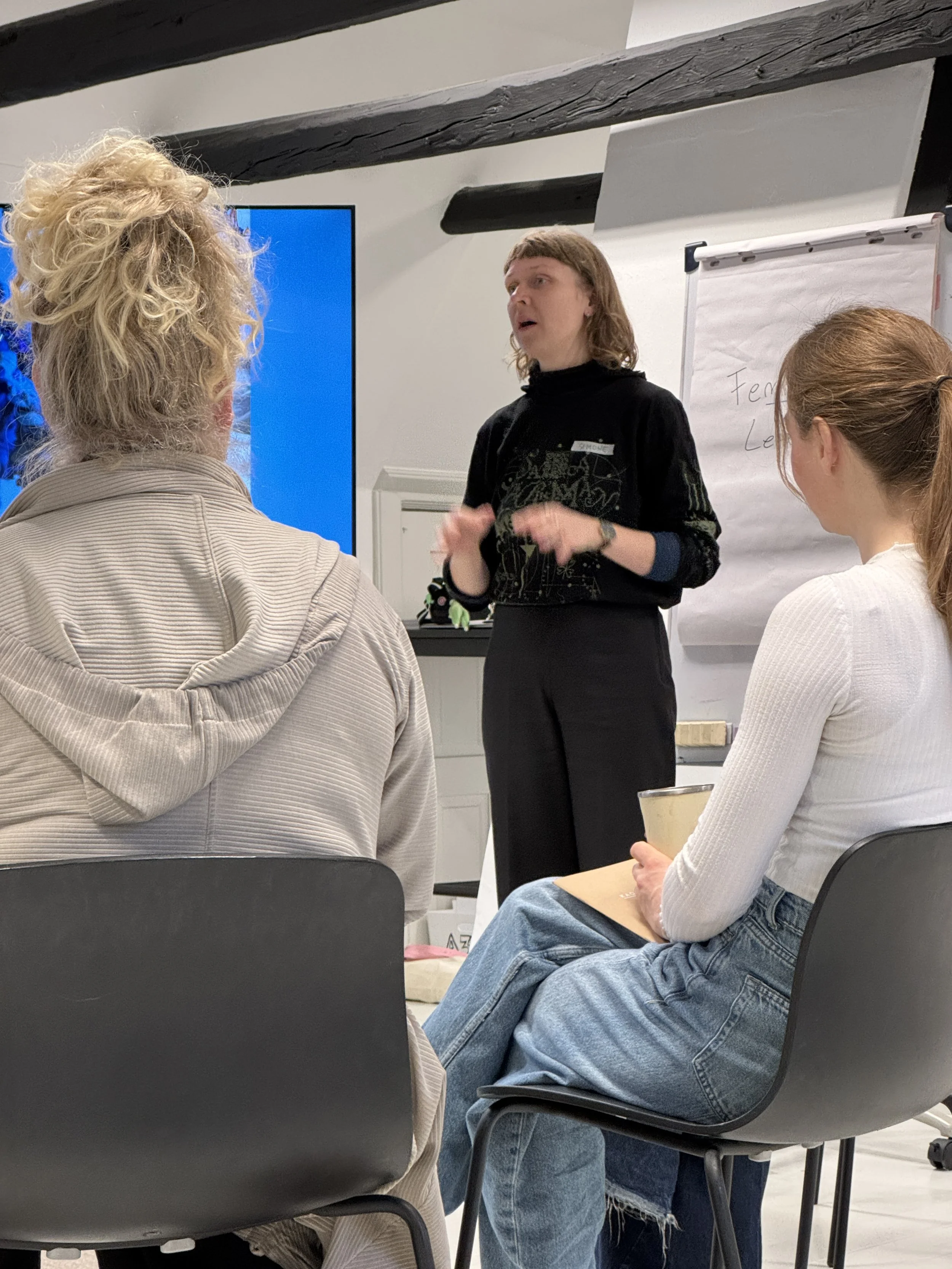
Our Feminist Leadership courses offer a practical and experiential exploration of power, relationships, influence and responsibility in organisations.
Through facilitated conversations, exercises and reflection, participants develop a language for understanding power and practical approaches to working with it in their own professional lives.
The courses are relevant to leaders, managers, consultants, project leaders and anyone interested in developing more collaborative, responsible and inclusive organisations.
We offer open professional courses in Denmark and tailored leadership development programmes for companies and organisations.
Explore our Feminist Leadership courses and consultancy services at LYNG Agency.
Further reading
Copenhagen Business School — Power is a dirty word – but essential to leadership.
Amy C. Edmondson — The Fearless Organization.
Srilatha Batliwala — Feminist Leadership for Social Transformation: Clearing the Conceptual Cloud.
Jo Rowlands — Questioning Empowerment: Working with Women in Honduras.